Blog
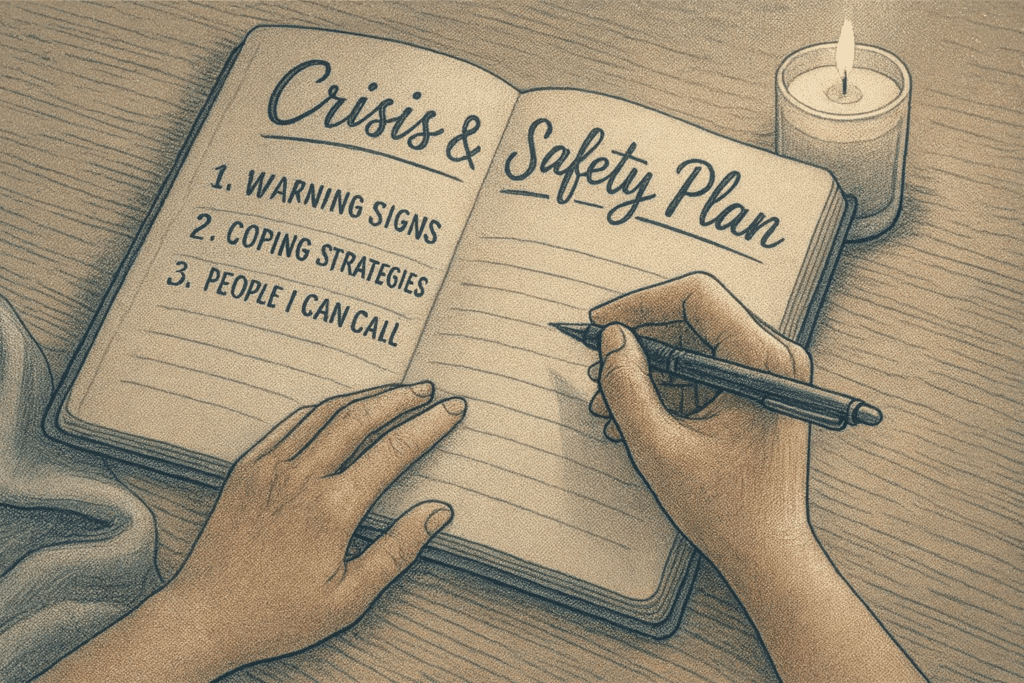
Safety Planning with Suicidal Thoughts
A solid and well thought out safety plan can significantly reduce the risk of an individual completing suicide through having access to support and knowing how to manage a crisis. Having a well constructed safety plan can also give the individual a sense of control during overwhelming moments so that they do not act impulsively. It is recommended that a safety plan is completed with a licensed mental health provider to ensure it is tailored to the individuals specific needs and circumstances.
First, we need to identify warning signs of potential suicidal ideation. This could include potential behaviors, emotions, thoughts, or environments that signal the need for intervention. Second, we will list coping skills or strategies that can be used when warning signs arise. This could be using specific distress tolerance DBT skills such as self soothing, exercising, listening to music, watching your favorite movie, taking a cold shower, etc. Third, we will create a list of trusted individuals that you can reach out to for support. (friends, family, professionals). We will need to ensure these contacts are aware you are on their list to reach out to in moments of feeling overwhelmed. Fourth, we will make a list of emergency contacts that you can reach out to in a moment of crisis such as that National Suicide Prevention Hotline: 1-800-273-8255 or 911. Then fifth, we will outline steps to keep your environment safe such as removing sharp objects and substances, putting medications in a medication lockbox, or securing firearms with gun locks. The final step does not prevent someone from completing suicide entirely, but slows down reactions in hopes to reduce impulsivity.
We want to make sure individuals have quick access to their safety plan, so printing out a copy and keeping it in your nightstand or having a digital version on your phone is recommended.
It is important to remember that each day there are people struggling with suicidal ideation that do not need hospital intervention. Sometimes hospitalization assessment or inpatient treatment is recommended if certain criteria is met, but this is not always necessary and needs to be discussed with a mental health clinician. Please consult with your mental health provider if you think creating a safety plan is a good choice for you or a loved one. Remember you are not alone and that there is hope and help even during the darkest moments.
-Madison Meyerson, LSCSW

How to Plan Ahead for Healthy Sleep When a Baby Arrives
Unbroken sleep is something we all take for granted - until we are no longer getting any. Most of us, when expecting our first baby, chuckle and nod at everyone’s “sleep while you can!” comments - not really knowing exactly what we’re getting ourselves into.
You know how important sleep is. From your hormone and metabolic health, to your mental health and stability, to your body’s ability to restore and heal itself, sleep is the great reset that keeps our body going and is just as vital as healthy food and clean water.
How much thought have you given to preparing yourself and your household to healthy sleep once your baby arrives? Let’s look at the reality of newborn sleep, and some strategies you can implement to maximize the amount of sleep you and your family can get.
What Will My Baby’s Sleep Look Like?
A newborn’s needs change pretty rapidly in the first few months. We’re going to look at the first 3 months to see what your newborn’s sleep will look like and what strategies you can implement.
Month 1: The Reality
Your brand new baby will likely sleep at least 20 out of every 24 hours – and most of the longer stretches will be during the day. Because you rocked your baby to sleep all day in the womb with your movement and activity, and laid quietly at night, your baby will be born with day-night confusion. Your newborn will also need to eat every two hours around the clock. Whether you are breastfeeding or bottle feeding, you will be up around 1, 3, 5, 7 and so on to feed, burp, diaper, swaddle, and then close your own eyes for a few minutes until the next feed.
Month 1: The Strategies
Your first month postpartum requires a two-part strategy: support, and teaching the difference between day and night. Rely on whatever support system you have. You must have one unbroken 4-hour stretch of sleep per 24 hours, no matter what. Maybe your spouse or partner takes that 4-hour shift in the evening, or the early morning. Maybe you have a friend or relative come over in the afternoon to get you that nice nap. If possible, hire a postpartum doula for either overnight or daytime shifts - do whatever it takes.
Secondly, begin teaching your baby the difference between night and day from Day One. Without your guidance, baby will not develop their own circadian rhythm for about 3 months. You should take your baby outside for a few minutes each morning to look at the sunrise, and take a couple other outdoors “trips” throughout the day, whether that be just to the mailbox or just to sit on the porch, or even to take a 5 minute walk with the stroller if you feel up to it. In the evening, avoid bright lights, screens, and phone use as much as possible. For night feeds, try to avoid turning on bright lights. A small orange or red nightlight is fine to feed and change the diapers by. Turn off or cover up any electronic devices in your bedroom and/or the baby’s nursery which emit blue or blinking lights.
Month 2: The Reality
In your baby’s second month, as long as they are healthy and gaining weight, their pediatrician will likely sign off on them going longer stretches at night between feeds. Your 2 month old baby may be able to go 3, 4, or even 5 hours at night in between feeds if you are setting them up for success during the day. Your two month old baby requires about 16-20 hours of sleep out of every 24 hours, and may not take as lengthy naps now.
Month 2: The Strategies
You’ll want to offer your baby full, frequent feeds every 2 hours during the day, to support their ability to sleep longer stretches at night. Offer a paci, white noise, and swaddle for all naps for the best success. You may be able to cut back on help since you’re getting longer stretches at night, but be sure you still get at least that 4 hour unbroken stretch of sleep at some point each day. Lay your baby down in their crib, swaddled, for naps each day at least twice per day. If baby prefers contact napping, later in the day and evening are the preferred times for contact napping. Ideally, your baby will get used to doing some naps in the crib!
Month 3: The Reality
Your baby may begin taking shorter naps during the day - which can be frustrating if you’ve been used to napping, showering and eating during long naps! If your baby wasn’t doing any longer stretches at night before, they should be able to go 3-6 hours at a time overnight at this point. Your baby also may be a lighter sleeper now, startling awake at the door closing, floor creaking, or dog barking.
Month 3: The Strategies
Encourage healthy naps by laying baby down in a dark room, with a sleep sack, paci and white noise - after a nice full feeding every 2.5-3 hours. Lay baby down in crib drowsy but awake for all naps - this ensures that they don’t wake right back up after only 20 minutes of napping! Provide plenty of stimulation during their wake times, including eye contact, singing, going outside, showing them toys, and tummy time near a small mirror or colorful toy. Increase the amount of awake time in between naps to about an hour or hour and fifteen minutes - don’t allow your baby to sleep all day without good playtimes or they won’t want to sleep at night.
The Takeaways
Being willing to rely on your support system (or being willing to ask for help and create your own support system) is key - we were never meant to do all of this alone. Learning about how to encourage your baby to sleep well, rather than just “seeing how it goes” is another way that you can love yourself and your family in your postpartum period. By planning ahead for support, educating yourself on healthy sleep habits, and encouraging your baby to learn the difference between day and night, you can get through your postpartum period without suffering from severe sleep deprivation. Don’t wait until you are in the trenches of newborn care - during your pregnancy, make a plan with your spouse and social circle to support you or reserve a professional postpartum doula to be available for your due date.
- Sara Skiles is a certified birth and postpartum doula, certified pediatric sleep consultant, and advanced newborn care specialist in the Wichita, Kansas area. Sara specializes in helping new parents enjoy a low-stress, well-rested, and seamless postpartum recovery through education, hands-on support and guidance, and especially overnight newborn care. With 14 years of experience as a postpartum doula, Sara and her team are the ideal companions for any new parent. Sara lives in Bel Aire, KS with her husband, two sons, and their kitty April. View Sara’s doula services at www.WichitaDoula.com and her overnight newborn care services at www.wichitababyco.com.